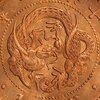
I think we need “常平庁”.
"Stabilization Office" ( 常平廳(Sangpyongchong) ),?
But,I don't have infomation about it.I just know,it is in the Korean Peninsula.
Sangpyongchong made Oldest Sang Pyong Tong Bo.
Este tema se publicó en el foro en inglés.
» Acceso rápido al último mensaje
I think we need “常平庁”.
"Stabilization Office" ( 常平廳(Sangpyongchong) ),?
But,I don't have infomation about it.I just know,it is in the Korean Peninsula.
Sangpyongchong made Oldest Sang Pyong Tong Bo.
amakitu_Japan
I think we need “常平庁”.
"Stabilization Office" ( 常平廳(Sangpyongchong) ),?
But,I don't have infomation about it.I just know,it is in the Korean Peninsula.
Sangpyongchong made Oldest Sang Pyong Tong Bo.
What do you think, administrators?
Necessity, information, etc.
Hello,
I also think it would be good to record this mint accurately, but there is a point of concern.
As far as I know, Sangpyeongcheong (常平廳) was another name for Jinhyulcheong (賑恤廳). Strictly speaking, it was called Sangpyeongcheong during normal times, but in times of war or disaster it was renamed Jinhyulcheong.
Here is an explanation from a Korean reference:
“In ordinary times it was called Sangpyeongcheong, but when famine relief began it was renamed Jinhyulcheong (賑恤廳), and it was also commonly referred to as Sangjincheong (常賑廳). From the mid-Joseon period, Sangpyeongcheong was established in the central government to manage relief grain in each province. However, after the Imjin War it became ineffective, and in 1626 (the 4th year of King Injo) it was incorporated into the Sunhyecheong (宣惠廳) along with the Gyeonggicheong that administered the Daedong law. At that time, the Guwhangcheong (救荒廳, ‘Relief Office’) operated by the Bibyeonsa (備邊司) was merged with it, so that in normal times it managed grain under the name Sangpyeongcheong, and in years of famine it was renamed Jinhyulcheong to take charge of relief work.”
As mentioned, Sangpyeongcheong (常平廳) and Jinhyulcheong (賑恤廳) can be seen as the same institution, with the name changing depending on circumstances. In normal times it was called Sangpyeongcheong, while in times of famine or emergency it was called Jinhyulcheong.
I agree with the poster that it would be good to add this as a new mint. Although it was the same institution, its roles and names varied, and in Korea we usually distinguish the terms.
Established: 1633
Merged into another office: 1753
Location: Seoul, Korea
This should clarify its historical context and help represent it accurately in the catalog.
Thank you for the detailed explanation!
I never imagined that an institution would change its name...
Could you add it?
About a mint that change of name, guidelines say
https://en.numista.com/help/add-or-modify-a-mint-in-the-catalogue-189.html
I think it is the first case:
Name
and the description should mention the reason of the names.
Thank you! Based on your explanation, I would propose the following:
Name
(EN) Charity Office / Ever-Normal Granaries
(local) 賑恤廳 (Chinhyulcheong) / 常平廳 (Sangpyeongcheong)
The institution was known as Sangpyeongcheong (常平廳) in normal times, but during periods of famine, when famine relief operations were activated, it was referred to as Chinhyulcheong (賑恤廳).
According to descriptions,
Sangpyeongcheong was responsible in normal times for price stabilization, management of grain, cloth, and cash, and coin production. In times of emergency such as war or severe famine, these functions were reduced, and famine relief operations were initiated using stored grain. In this context, the institution functioned as Chinhyulcheong, focusing on relief activities.
Taking into account this description, the institutional name, and the English terminology used for the Chinese institution with the same function and name, it seems to consider “Ever-Normal Granaries” as a possible English rendering.
The reason for placing Chinhyulcheong before Sangpyeongcheong is that most of the coins were produced under the name Chinhyulcheong.
Ok. I would also take advantage this request to add or correct more information to the page of the mint:
Okay,
Regarding the operation dates, both ranges reflect different interpretations:
The Chinhyulchong (賑恤廳, Charity Office) was not a permanent institution in its early history.
It was first established temporarily in 1511, and its first official installation occurred in 1525.
Afterward, the office was repeatedly established and abolished, depending on famine conditions and fiscal needs.
In 1626, the Sangpyeongcheong (常平廳, Ever-Normal Granaries)—a relatively new institution formed in the early 17th century—was merged and coordinated with the Chinhyulchong.
ㆍAlthough the exact date of Sangpyeongcheong’s foundation is unclear, the first mention in government records dates to 1608.
Following the merger, the combined institution was regularized as a standing office and placed under the supervision of the Sonhyechong (宣惠廳, Rice and Cloth Department).
In 1633, through deliberation within the central government, the first casting of Sangpyeong Tongbo(The monetary system discussed in this post, Currency of monarchical Korea) was carried out.
At this stage, the coin was not yet a nationally standardized currency, but rather produced and circulated locally in limited regions.
In 1661, Chinhyulchong became independent from the Sonhyechong. and was attached to the Pibyon sa (備邊司, National Defense Bureau).
However, in 1686, it was once again placed under the authority of the Sonhyechong.
In 1678, the government officially proclaimed Sangpyeong Tongbo as a state currency.
From this point onward, the Chinhyulchong began minting the coin.
Later, in 1750, Chinhyulchong came under the administration of the Kyunyokchong (均役廳, Government Tithe Office).
In 1753, following the integration of the Kyunyokchong, the institution was once again subordinated to the Sonhyechong, a point generally regarded as its effective endpoint.
Finally, amid the large-scale administrative reforms undertaken in the late 19th century, immediately prior to the proclamation of the Empire, the Chinhyulcheong was officially abolished in 1894.
WonYoungJun
Okay,
Regarding the operation dates, both ranges reflect different interpretations:
[…]
It is a bit complicated.
Questions… When you say…
I group the events under each mint.
Chinhyulchong (賑恤廳, Charity Office) – 1679-1752
Sangpyeongcheong (常平廳, Ever-Normal Granaries)
https://en.numista.com/catalogue/mint.php?id=5000
I suggest something like:
Sonhyechong (宣惠廳, Rice and Cloth Department) – 1742-1836
https://en.numista.com/catalogue/mint.php?id=5002
Edit: I apply https://en.numista.com/forum/topic166297.html#p1315485
Add/modify:
Pibyon sa (備邊司, National Defense Bureau) – 1742
https://en.numista.com/catalogue/mint.php?id=5005
Edit: I apply https://en.numista.com/forum/topic166297.html#p1315485
I suggest something like:
Kyunyokchong (均役廳, Government Tithe Office) – 1807-1883
https://en.numista.com/catalogue/mint.php?id=4998
Edit: I apply https://en.numista.com/forum/topic166297.html#p1315485
I suggest something like:
Except for the parts I explained ambiguously, everything is accurate.
1.
So Chinhyulcheong and Sangpyeongcheong are not the same institutions? They were created at different times and later combined. Right?
ㆍYes.
2.
The combined institution was known as Sangpyeongcheong in normal times and as Chinhyulcheong during periods of famine. Right?
ㆍYes. It was also occasionally and informally referred to as Sang chinh cheong.
(Sangpyeongcheong / Chinhyulcheong)
3.
Was it only Chinhyulcheong that was transferred, or the combined Chinhyulcheong / Sangpyeongcheong institution?
ㆍThe combined Chinhyulcheong / Sangpyeongcheong institution was transferred in its entirety.
All references to Chinhyulcheong after this point refer to the combined institution.
4.
Does this mean that the Kyunyokcheong was integrated into the Sonhyecheong in 1753?
ㆍYes. More precisely, the Kyunyokcheong came under the supervision of the Sonhyecheong.
ㅡRegarding the suggested classifications
Chinhyulcheong (賑恤廳, Charity Office)
Dates: 1626–1894 (combined institution only)
This is a personal view, but since the two institutions became a permanent standing office after their merger, I think this date range is appropriate.
Sonhyecheong (宣惠廳, Rice and Cloth Department)
Dates: 1608–1894
Description: A state office responsible for collecting and administering taxes in the form of rice, cloth, and coins instead of tribute goods (local specialties).
Pibyeonsa (備邊司, National Defense Bureau)
Dates:
1510–1554 – A temporary institution established during times of war or armed conflict
1554–1864 – Due to frequent wars, it became a permanent body; in the 19th century, its excessive concentration of power led to deliberate reorganization (institutional division) and eventual abolition
Description: Responsible for the planning and maintenance of national defense, as well as the direction and supervision of state administrative affairs.
Kyunyokcheong (均役廳, Government Tithe Office)
Dates:
1750 – Temporarily established
1751 – Formally instituted
1753–1894 – Subordinated to the Sonhyecheong
Thereafter, it appears to have continued without major change as a subordinate office of the Sonhyecheong.
Description: It functioned as a fiscal institution responsible for managing the military tax.
ㅡㅡㅡㅡㅡ
Additional explanation: these institutions were mostly mid-level government offices and were frequently integrated, merged, or subordinated to other bodies.
For example, among the higher-level institutions are the Hojo, which is the Ministry of Finance, and the Byeongjo, which is the Ministry of Military Affairs.
WonYoungJun
Except for the parts I explained ambiguously, everything is accurate.
[…]
I copied and applied your entire response to my previous post https://en.numista.com/forum/topic166297.html#p1315453 (for now I am writing all the information there).
WonYoungJun
ㅡRegarding the suggested classifications
Chinhyulcheong (賑恤廳, Charity Office)
Dates: 1626–1894 (combined institution only)
This is a personal view, but since the two institutions became a permanent standing office after their merger, I think this date range is appropriate.
Numista has coins from 1679-1752 https://en.numista.com/catalogue/index.php?mi=5000&p=1 nothing before 1626, so it is possible.
WonYoungJun
Kyunyokcheong (均役廳, Government Tithe Office)
Dates:
1750 – Temporarily established
1751 – Formally instituted
1753–1894 – Subordinated to the Sonhyecheong
I assume it was closed in 1894.
---------------------
I think everything is correct, but review for possible errors.
When all correct I will post in a reply all requests to do (for example, the names in English have an error with the character “)”).
In the English descriptions I keep the name in local language (with Latin script) instead of the name translated into English. I do not know if this is correct in English. As a Spanish translator I will translate the names.
I’ve checked them and it all looks correct.
Thank you for your interest and the effort!
Add or modify these information in mints from South Korea… @amakitu_Japan Please, change the subject in the first post (for example, Modify mints from South Korea) and add a link to here (to make the request easier to find).
⚠️ In the English descriptions I keep the name in local language (with Latin script) instead of the name translated into English. I do not know if this is correct in English.
⚠️ The pages title of these four mints have the same error. A closed parentheses is displayed between the name in English and the location. I think this problems occurs when the local name includes text in parentheses, like these Asian mints, that use the local name:
name_with_local_script (name_transliterated_into_Latin_script)

These mints do not use parentheses in their local names and do not have the problem:
So, I think the name local do not should to include parentheses:
name_with_local_script / name_transliterated_into_Latin_script
Sonhyechong (宣惠廳, Rice and Cloth Department) https://en.numista.com/catalogue/mint.php?id=5002
Pibyon sa (備邊司, National Defense Bureau) https://en.numista.com/catalogue/mint.php?id=5005
Kyunyokchong (均役廳, Government Tithe Office) https://en.numista.com/catalogue/mint.php?id=4998
Chinhyulchong (賑恤廳, Charity Office) https://en.numista.com/catalogue/mint.php?id=5000
----------------------------
It was an institution that arose from the combination of two others. The first, the Chinhyulchong was first established temporarily in 1511, and its first official installation occurred in 1525; afterwards, the office was repeatedly established and abolished, depending on famine conditions and fiscal needs. The second was the Sangpyeongcheong, and its first mention dates to 1608.
Sangpyeongcheong was responsible in normal times for price stabiliaation, management of grain, cloth, and cash, and coin production. In times of emergency such as war or severe famine, these functions were reduced, and famine relief operations were initiated using stored grain. In this context, the institution functioned as Chinhyulcheong, focusing on relief activities.
In 1626 both were merged and coordinated, and the combined institution (occasionally and informally referred to as Sang chinh cheong) was regularised as a standing office and placed under the supervision of the Sonhyechong. It was separated from the Sonhyechong and attached to the Pibyon sa in 1661-1686, and to the Kyunyokchong in 1750-1753). Finally, amid the large-scale administrative reforms undertaken in the late 19th century, immediately prior to the proclamation of the Empire, it was officially abolished in 1894.
completion
@Jarcek The description of the last company (are three paragraphs) was not added.
La zona horaria usada es UTC+2:00.
La hora actual es 9:08.