Coins from Christendom

51 mensajes

Este tema se publicó en el foro en inglés.

» Acceso rápido al último mensaje

One of my main collecting themes is coins from the Eastern Christian kingdoms (this includes Byzantium). These coins have a lot of symbolism and history to them. Furthermore, I figured we should have an analogus thread to the "Islamic Coins" for "Christian Coins". So, go ahead and post your Christian coins here. I'll start off with the following coin:

Hungary: Charles Róbert (1307-1342) BI Denár (Huszár-450, Unger-357)

Obv: Christ standing facing within mandorla, raising right hand in benediction; in left, book of Gospels
Rev: Kneeling Angel facing left with a halo and cross

Similar to the Quran leaf in the other thread, here is a Bible leaf for this thread :)

1612 Edition of the King James Bible, 1st Quarto - The Crucifixion of Christ (Matthew 23:3 onward)

This is from the so-called 'HE' edition of the 1612 Roman-Type Quatro KJB (H313). The 'HE' refers to Ruth 3:15 as the verse was written as:

Also he said, “Bring the veil that thou hast upon thee and hold it.” And when she held it, he measured six measures of barley, and laid it on her; and he went into the city.

The 'SHE' edition of 1612 has the verse written as:

Also he said, “Bring the veil that thou hast upon thee and hold it.” And when she held it, he measured six measures of barley, and laid it on her; and she went into the city.

For further information, see Norton, David, A Textual History of the King James Bible, Cambridge University Press, 2005

Crusaders: Bohémond III (1163-1201) AR Denier, Antioch (Metcalf, Crusades-378)

Obv:+ BOAИVHDVS, helmeted and mailed head left; crescent before, star behind
Rev:+ AИTI:OCHIA, cross pattée; crescent in second quarter

Byzantine Empire: Michael VII Ducas (1071-1078) Æ Follis, Constantinople (Sear-1878; DOC-14b)

Obv: Bust of Christ Pantokrator facing, bearded, with cross behind, wearing tunic and himation; right hand raised before breast in blessing, left hand holds book from beneath. In field, IC and XC above lateral arms of cross; six-pointed stars beneath them to left and right
Rev: +MIX AHΛ RACIOΔ; Crowned bust of Michael facing, bearded, wearing modified loros with collar-piece and crown with cross and pendilia, holding in right hand labarum, in left globus cruciger

Bulgaria: Todor Svetoslav (1300-1322) AR Grosh, Veliko Turnovo Mint (Raduchev & Zhekov 1.8.1-3)

Obv: Christ Pantokrator enthroned facing, IC XC across field
Rev: Todor Svetoslav standing facing, holding cross-tipped scepter

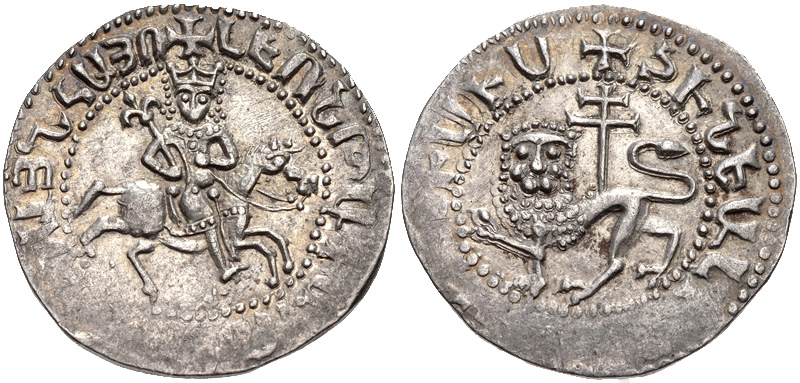
Cilician Armenia: Levon II (1270-1289) AR Tram (Nercessian-376v; CCA-1429)

Obv: King on horseback to right, holding reins with left hand, and a cross in right hand with two bars extending over his right shoulder. Clockwise legend, ԼԵՒՈՆ ԹԱԳԱՒՈՐ ԱՄԵՆԱՅՆ ՀԱՅՈՑ (Lewon Tagawor Amenayn Hayo; Levon, King of all Armenians)
Rev: Crowned lion walking left, with left paw raised. Behind him a cross with two bars. Clockwise legend, ՇԻՆԵԱԼ Ի ՔԱՂԱՔՆ Ի ՍԻՍ ԻՍ (Shineal i kaghakn i Sis; Struck in the city of Sis)

Bosnia: Štefan II Tomaševič (1461-1463) AR Dinar (Jovanovic-62.2)

Obv: crowned and veiled helmet left set on royal coat-of-arms; R and five-rayed star set in six-rayed star on either side of helmet; Legend around - STEFAn •CRAGL
Rev: St. Gregorius standing facing, raising hand in benediction and holding crozier; Legend around - S GREGO RI • PAPE

Hungary: Ferdinánd I (1526-1564) BI Denár (Huszár-935, Réthy-40, Unger-745a)

Obv: FERDINAND · D · G · R · VNG ✶ 1537 ✶; Quartered Coat of Arms (strips, double cross, leopard heads, Bohemian lion), at the heart , Austrian Shield
Rev: PATRONA · ✶ · VNGARIE; Virgin Mary, crowned, enthroned facing, holding infant Jesus; across field, K-B (Kremnitz)

Hungary: Béla IV (1235-1270) AR denár (Huszár-310; Unger-233)

Obv: BELAE REX around Hebrew tet (ט)
Rev: Angel slays dragon

This coin is holier than most coins I own :D...

Byzantine Empire: Constantine X Ducas (1059-1067) AR ⅔ Miliaresion, Constantinople (Sear-1851; DOC 6d)

Obv: + ӨKЄ ROHӨЄI; Theotokos orans standing facing; MHP ӨV across field
Obv: + ӨKЄ RO/HӨЄI KШN/CTANTINШ/ΔЄCΠOTH/TШ ΔUKAv in seven lines; — • — above and below legend

This coin is from Dato Mikeladze's collection, but it is just so awesome that I wanted it in this thread as well. Kudos on this acquisition Dato!!

Medieval Georgia: Queen Rusudan (1223-1247) AR Dirhem (Lang-14)

Obv: Bust of Christ facing, wearing nimbus, pallium and colobium and raising right hand in benediction, holds ornamented book of Gospels in left hand. IC ΧC (Ιησούς Χριστός) in field
Marginal Georgian Asomtavruli legend: ႱႠႾႤႪႨႧႠႶႧႨႱႨႧႠႨႽႤႣႠႵჃႬ (in the name of God, was struck in the K’oronikon 450 (1230AD))

Rev: In the centre of an ornamented frame, three Asomtavruli letters ႰႱႬ (Rusudan)
Marginal legend: ملكة الملكات جلال الدنيا والدين روسدان بنت تامار ظهير المسيح (Queen of the Queens, glory of the world and faith, Rusudan, daughter of Tamar, champion of the Messiah)

Aksumite Empire: Armah (ca. 630-650) Æ Unit (Hahn, Aksumite 72a; Munro-Hay Type 153; BMC Axum 577)

Obv: Crowned and draped full-length figure of Armah, wearing beaded necklace, enthroned right, holding cruciform scepter
Rev: Openwork cross with central gilding connected to ring by stem; wheat stalks emerging from ring

Aksumite Empire: Ella Gabaz (ca. 610-630) Æ Unit (Hahn, Aksumite 70.2; Munro-Hay 120; BMC Aksum 414)

Obv: "King WZN" (in Ge'ez), draped bust right wearing headcloth, holding grain ear
Rev: "He who is Fitting for the People" (in Ge'ez), long cross with ends terminating in smaller crosses over a smaller Greek cross; gilding in center

Kingdom of Thessalonica: Theodoros Comnenus-Ducas (1224-1230) AE Trachy, Thessalonica (Sear-2168, Sommer-73.6)

Obv: Facing bust of Christ Emmanuel with scroll
Rev: Emperor with labarum and globe cruciger; manus dei above; Legend around - ΘΕΟΔWPOC ΔECΠOTHC KOMNHNOC O ΔOVKA/C

Hungary 1 Denár - Rudolf (1576-1608) ÉH# 810

Pics picked from the original auction I won.
Administrateur du catalogue, référent de nombreuses nations antiques et de la Lorraine.
Catalogue administrator, numerous Antique nations and Lorraine referee.
Byzantine Empire: Æ Anonymous Class D Follis, Attributed to Constantine IX (1042-1055), Constantinople Mint (Sear-1836)

Obv: IC - XC; Christ seated facing on throne with back, wearing nimbus cruciger, pallium and colobium, and holding book of Gospels with both hands
Rev: IS XS / bASILE / bASIL in three lines

Byzantine Empire: Æ Anonymous Class H Follis, Attributed to Michael VII (1071-1078), Constantinople Mint (Sear-1880; DOC H.5)

Obv: Facing bust of Christ Pantokrator
Rev: Patriarchal cross with globule and pellets at extremities, set on floral ornament

Hungary: Belá III (1172-1196) Follis (Huszár-72, Unger-114)

Obv: SANCTA—MARIA, Nimbate Madonna facing the front, scepter in right hand, infant Jesus in left. Two crosses above.
Rev: REX BELA on left, REX STS on right; Two kings seated on thrones facing, each holding scepter and globus cruciger; long cross between. Inverted crescent and three lines in exergue.

Bulgaria: Ivan Alexander (1331-1371) Grosso (Dimnik&Dobrinic-9.1.2)

Obv: Christ standing facing before seat, raising hands in benediction; IC XC and monograms across field.
Rev: Ivan Alexander and Michael Asen IV standing facing, each holding cross-tipped scepter, holding Christogram-tipped staff between them; monograms across field; stars flanking base of staff.

Serbia: Vuk Branković (1389-1398) AR Dinar (Jovanovic-113)

Obv: Vuk standing facing, bareheaded with banner and loros, Cyrillic legend around ВЛЬКЬ (VUK) on either side
Rev: Christ enthroned, partial Cyrillic legend ГАК/ВЬ on either side of Christ.

Italian states (Venetia) - 1 Zecchino - Lodovico Manin (1789-1797)

Obv : St. Mark standing at left presenting staff with cross
Rev : Full-length facing figure of Christ in beaded ellipse lined with stars.

"The saddest aspect of life right now is that science gathers knowledge faster than society gathers wisdom." ― Isaac Asimov
Blog : https://parimalscoincollection.blogspot.com
Picked up a few new coins for my collection, so I thought I could revive this dead thread :°

Empire of Nicaea: Theodore I Comnenus-Lascaris (1208-1222) BI Trachy, Magnesia (Sear 2067; DOC 7)

Obv: Christ Pantokrator standing facing; small crosses flanking
Rev: Theodore and St. Theodore standing facing, holding a labarum between them


Byzantine Empire: Michael VIII Palaeologus (1261-1282 CE) Æ Trachy, Constantinople (Sear 2259; DOC 46-51; PCPC 20.1-3)

Obv: Bust of Christ Pantokrator facing; K across field
Rev: Archangel Michael presenting kneeling emperor to Christ seated left

John the Baptist


Obverse: John the Baptist with Agnus Dei [God's lamb] on a book. Numbered [369] in left field, as all examples are for issuing. Lettering: PARATE VIA DNI [PARATE · VIAM · DOMINI]
Reverse: A representation of Faith, Hope and Charity with Charity the largest. Lettering:
IN CHARITATE NON FICTA / CONCORDIA

Described as 'An attractive and Original AE medal / Token. Issued by Vatican authorities to beggars and others receiving charity. An interesting and rare piece'.
Token collector [1600-1899] with some coins
Vatican City - Sede Vacante 500 Lire coins from 1978


"The saddest aspect of life right now is that science gathers knowledge faster than society gathers wisdom." ― Isaac Asimov
Blog : https://parimalscoincollection.blogspot.com
Poland, commemorative 2 Złote: Jubilee of Year 2000, Y# 376, 2000.
On reverse there is the tetramorph, i.e. the union of the symbols of the Four evangelists, derived from Inaugural vision in the Book of Ezekiel where the chariot is drawn by four living creatures, each having four faces (those of a man, a lion, an ox, and an eagle) and four wings:
  • św. Mateusz / Matthew: angel or winged man
  • św. Marek / Mark: winged lion
  • św. Łukasz / Luke: winged ox
  • św. Jan / John: eagle
ūūūūū
I have nothing of interest or value to add, I just want to follow this thread.
Byzantine Empire: Michael VIII Palaeologos (1261-1282) Æ Trachy, Constantinople (Sear 2260; Bendall-Donald C.2; PCPC 21)

Obv: MP - ΘV in upper field; Virgin nimbate, seated upon throne with back, with side panels each decorated with a saltire and four pellets; holds beardless, nimbate head of Christ on breast
Rev: Χ/Μ/ΔЄC/Π/ΤIC to left, Ο/ΠΑ/ΛЄ/OΛ to right; IC XC beside head of Christ; kneeling figure of emperor wearing divitision, collar-piece, and jeweled loros of simplified type, being presented by St. Michael, beardless and nimbate, to Christ, who crowns him with right hand and holds scroll in left
Wgt: 2.49g
Size: 27.13mm

A gallery of my coins and artifacts can been seen on FORVM Ancient Coins
Cita: "MonaSeaclaid"​I have nothing of interest or value to add, I just want to follow this thread.
​Me too
Oid ¡mortales! el grito sagrado:
¡Libertad, libertad, libertad!
Germany, Aachen: Frederick II (1220-50) AR Denar (Menadier-62)

Obv: ✚ • FRID ⲈRIC’ • ; Emperor seated facing
Rev: ✠ INPⲈ RTOR; Bust of Charles the Great with castle behind

A gallery of my coins and artifacts can been seen on FORVM Ancient Coins
Cita: "Quant.Geek"Aksumite Empire: Armah (ca. 630-650) Æ Unit (Hahn, Aksumite 72a; Munro-Hay Type 153; BMC Axum 577)

​Obv: Crowned and draped full-length figure of Armah, wearing beaded necklace, enthroned right, holding cruciform scepter
​Rev: Openwork cross with central gilding connected to ring by stem; wheat stalks emerging from ring


What is the purpose of the gilding? Is there enough gold to add much to its face value, or is it purely decorative? This surely must count as one of the earliest bi-metallic coins.

You have an incredible collection. Thank you for sharing it with us. ​
Crux Pellit Copper of James III of Scotland

This is one of the earliest post-Roman copper coins in Europe. Its introduction (alongside copper farthings) was regarded by contemporaries as being a factor that led to a coup d'état against James III in 1482. The official that was supposedly responsible for their introduction was hanged.

The coin's Christian iconography is pretty clear. The reverse legend reads: CRVX PELLIT OMNE CRIMEN (the cross drives away all sin), hence the name Crux Pellit Copper.
Cita: "cmaclean"
Cita: "Quant.Geek"Aksumite Empire: Armah (ca. 630-650) Æ Unit (Hahn, Aksumite 72a; Munro-Hay Type 153; BMC Axum 577)
​​
​​Obv: Crowned and draped full-length figure of Armah, wearing beaded necklace, enthroned right, holding cruciform scepter
​​Rev: Openwork cross with central gilding connected to ring by stem; wheat stalks emerging from ring
​​
​​
​​


​What is the purpose of the gilding? Is there enough gold to add much to its face value, or is it purely decorative? This surely must count as one of the earliest bi-metallic coins.

​You have an incredible collection. Thank you for sharing it with us. ​


Thanks for the complement! I am glad you are enjoying them as do I. ​There have been a lot of study on the Axumite gilding process and why they gilded their coins. There are varying theories, but nothing concrete. As the number of gold coins decreased, some speculate that it was to increase the value of the copper and silver coins by gilding important religious icons on the coin. This also was extended to the crown of the King. Others speculate that it was purely decorative as several religious items have been found that was gilded. Here are a few others in my collection:

Aksumite Empire: Anonymous (ca. 440-470) Æ Unit (Hahn, Aksumite 36.2; Munro-Hay Type 76; BMC Axum 316)

Obv: Crowned bust right, holding cruciform scepter
Rev: Greek cross within circle, central element with gold inlay


Aksumite Empire: Ella Gabaz (ca. 610-630) Æ Unit (Hahn, Aksumite 70.2; Munro-Hay 120; BMC Aksum 414)

Obv: "King WZN" (in Ge'ez), draped bust right wearing headcloth, holding grain ear
Rev: "He who is Fitting for the People" (in Ge'ez), long cross with ends terminating in smaller crosses over a smaller Greek cross; gilding in center


Aksumite Empire: Kaleb (ca. 510-540) AR Unit (Hahn, Aksumite 42; Munro-Hay Type 111; BMC Axum 411-12)

Obv: ነገሠ ከለበ (neguš Kaleb; King Kaleb); Crowned bust right; cross above
Rev: ለሀገረ ዘየደለ (la-hagar ze-yedlu (or za-yedallu); May this be (or he who is) suitable for the city/country); Bust right, wearing headcloth; cross above

A gallery of my coins and artifacts can been seen on FORVM Ancient Coins
I am still far behind in my task of classifying and photographing coins I purchased 8 months ago. Here is a coin from a hoard I bought around that time that I just got around to photograph. Its within topic :°:

Byzantine Empire: Andronicus III Palaeologus (1328-1341) Æ Assarion (Sear-2487; DOC 929; LPC 240.11; PCPC 261; Lianta-839)

Obv: St. Demetrius, beardless and nimbate, seated upon throne without back; holds sword across knees
Rev: Three-quarter-length figure of Andronicus wearing stemma, holding lis and cruciform scepter; stars in field


A fuller example of the above coin:

A gallery of my coins and artifacts can been seen on FORVM Ancient Coins
Coins are pilling up and I just don't have any time. I should probably take a picture of my desk at home to show the pile of coins on my desk (and the box of coins on the floor!). Been too busy with work. Here is a coin I purchased this month that I was able to squeeze some time to attribute:

Normans in Sicily: Roger II (1130-1154) AR Ducale, Palermo (Spahr 72; MEC 212; Biaggi 1770)

Obv: + IC • XC • RG • IN AE TRN (Jesus Christus regnat in aeternum); Bust of Christ facing, wearing nimbus cruciger, pallium and colobium, and raising right hand in benediction; in left hand, book of Gospels
Rev: King Roger and his son Roger, duke of Apulia, staff with cross at each end between them, beneath the king R RX SCLS (Rogerius Rex Siciliae), beneath the duke, R • D X • AP (Rogerius Dux Apuliae) and AN R X (Anno decimo del regno) between them


As always, you can go here to view my gallery:

http://www.forumancientcoins.com/gallery/index.php?cat=36484
A gallery of my coins and artifacts can been seen on FORVM Ancient Coins
If your collection is getting out of hand I could take care of a few for you. 0:)

I love these posts!
Cita: "MonaSeaclaid"​If your collection is getting out of hand I could take care of a few for you. 0:)

​I love these posts!

​My hobby is becoming a full-time job lately and I need to scale down a bit. I am trying to refrain from buying new coins in the next few months while I sort out things. Lets see how that lasts :°
A gallery of my coins and artifacts can been seen on FORVM Ancient Coins
A new attribution to an old acquisition...

Empire of Nicaea: John III Ducas-Vatazes (1222-1254) Æ Trachy, Thessalonica Mint (Sear 2095; DOC IV, 41)

Obv: MP - ΘV in upper field; Virgin nimbate, seated upon throne with back; holds beardless, nimbate head of Christ on breast
Rev: IШ OΔϪKAC in two columnar groups, Full-length figure of emperor wearing stemma, divitision, collar-piece, jeweled loros of simplified type and sagion; right hand holds labarum-headed scepter; left hand holds globus cruciger; Star often on sagion to left or right (or both)


Believe it or not, the condition of these coins are pretty good in comparison to the coins stored in the Ashmolean Museum:

A gallery of my coins and artifacts can been seen on FORVM Ancient Coins
Looks like long lost treasure...(;0
          'We make a living by what we get, we make a life by what we give.'
                                                      Sir Winston Churchill
Been a while since I posted on this thread.

Duchy of Athens: Guy II de la Roche (1287-1308) BI Denier Tournois, Athens (CCS 93)

Obv: ✠ ❜CVI•DVX✿ATNS❜, or various other stop marks; Cross pattée
Rev: ThBANI✿CIVIS, or variation; Castle tournois
Dim: 20 mm, 0.88 g

A gallery of my coins and artifacts can been seen on FORVM Ancient Coins
I think I have something to include here.

Roman Empire: Constantinus I, Follis, Arelate (RIC VII 400)
Obverse: VRBS ROMA, helmeted, mantled bust of Roma left
Reverse: wolf and twins left, chi-rho above. Mintmark PCONST.

The detail is in the presence of chi-rho, a christian symbol, in a roman coin.
It's the only VRBS ROMA variant to have this symbol (checked on Wildwinds), and is certainly one of the very first coins with some kind of christian symbol or image.

PS.: got this coin by luck, I remember there were 3 at the fair where I bought it, I was simply choosing for the best-looking one, noticed the chi-rho only at home.
I am bumping this thread to ask a question (at the end).

I have a theme in my collection of coins with images of Christian saints, similar to that of the OP. This came about because I already had quite a few medieval/early modern European coins with such images, and then became interested in the history of the cult of saints in Christianity. Of course, the "back story" of why certain saints are featured on the coins of certain places is the most interesting part. For example, why St. John the Baptist is featured on the coins of Florence, or why St. Peter was featured on the coins of so many places in medieval Germany.

On another forum, there was a thread that ran in 2020 devoted to this topic, with lots of nice examples: https://www.coincommunity.com/forum/topic.asp?TOPIC_ID=367831

My question is this: the practice of minting coins with a sign of civic authority on the obverse (for instance, the name of the reigning king or duke and their coat of arms), and an image of a saint on the reverse is clearly derived from Roman and Byzantine coin traditions (picture of a god reverse).
Can anyone refer me to a reference on the this practice in antiquity? When it began? Why certain gods were pictured on certain coins? And so on...
Cita: "tdziemia"​My question is this: the practice of minting coins with a sign of civic authority on the obverse (for instance, the name of the reigning king or duke and their coat of arms), and an image of a saint on the reverse is clearly derived from Roman and Byzantine coin traditions (picture of a god reverse).
​Can anyone refer me to a reference on the this practice in antiquity? When it began? Why certain gods were pictured on certain coins? And so on...


​Have a nice day and good health.

The Christian "God" cannot be displayed ( is in everything and ubiquitous ), The Muslim faith, as far as I know, thus forbids the Qur'an to directly paint and draw one's own .....
You are, as I know, an experienced person- so I will just give a few opinions.

I think that it is necessary to look for the politics and interests of rich families and bishops at that time -determined everything in Europe, mainly to stay in power and defeat even -all and increase your ego and -richer.
So look for politics behind everything ( Without partying, you are a colleague now, I think 50/50, and so far without the desire to beat by hand -Well, the Middle Ages were 100 times stronger in religious and political)

I will speak for us here in the heart of Europe:
Our first coins and the saints depicted on them belong to the present day The patron of our country and mostly the guy have all seen the horse. It is especially accused of paying fees to the "Germans" and therefore on many coins it is simply is embodied policy ,,this is an example,,
https://cs.wikipedia.org/wiki/Svat%C3%BD_V%C3%A1clav

http://www.pokladnice-minci.cz/sv-vaclav-mince-a-medaile/

https://www.google.com/search?q=mince+svat%C3%A9ho+v%C3%A1clava&tbm=isch&ved=2ahUKEwjN4ueP1OfxAhXKIhoKHZSYBnUQ2-cCegQIABAA&oq=mince+svat%C3%A9ho+v%C3%A1clava&gs_lcp=CgNpbWcQDFAAWABgh6xtaABwAHgAgAEAiAEAkgEAmAEAqgELZ3dzLXdpei1pbWc&sclient=img&ei=XYTxYI3AF8rFaJSxmqgH&bih=500&biw=1093&rlz=1C1NHXL_csCZ927CZ927

But here I have such an appetizer for you. found Czech coin in Israel -Saint "Christopher" and the Czech King? during the Crusades in the Middle Ages:
Ottokar II-Iron and Golden King 1233-78 lived
https://www.reflex.cz/clanek/zpravy/53198/v-izraeli-objevili-ceskou-minci-z-doby-premysla-otakara-ii-je-to-nejstarsi-takovy-nalez.html

I have my own pain and injustice:
Saints Cyril and his brother Methodius -They were to bring independence and honor, but in the Middle Ages them political religious leverage they had no chance until after the emergence of independence.

https://cs.wikipedia.org/wiki/Cyril_a_Metod%C4%9Bj

https://www.google.com/search?q=Mince+sv.Cyril+a+Metod%C4%9Bj&rlz=1C1NHXL_csCZ927CZ927&sxsrf=ALeKk03e8tfsrZ4ehlytg-bcl0pLvmXdvQ:1626443350682&source=lnms&tbm=isch&sa=X&ved=2ahUKEwi4kqjR3efxAhVIwKQKHa2GBuYQ_AUoAXoECAEQAw&biw=1093&bih=500
I myself face this misunderstanding and my coin is therefore from an unknown country-Saint Methodius with his entourage of St. Gorazda and the others carry the remains of St. Cyril +and St. Constantine ( which they obtained from the Khazars beyond the Black Sea) etc. etc.
https://gorazduv-denar.webnode.cz

To this day, the issue is warm, you understand me. There are always interests and politics.

Nice greetings Ivan
I'm very sorry and a great apology ,, tdziemia ,, -I saw "Christianity," and my brain darkened .

Now I have looked and your question was not to the Middle Ages but to antiquity. So please excuse me.

That's why I'll lighten it with humor: It started at a time when guys and boys were involved in sports ( (I point to the beginning of the Olympics in Tokyo )
,, The boys just played and the girls beautified themselves in front of the mirror,, In the evening, wine in pottery was pulled out and the animal also had a headache -Well, the philosophers came to school and it started.
basketball, volleyball, handball

running disciplines
I recently introduced Philip II and his equestrian winnings on horseback -I will not repeat
wine and entertainment balls, parties
girls and women had time to dress up and beautify jewelry, dresses, hairstyles

And then those you ask intervened in this and everything went into...................
So I react to the relief and even more quickly and I'm sorry to read less.
sorry.
Ivan
Thanks for both comments!

I have this theme in my collection (coins with images of figures from Christianity) organized by these categories according to the images on the coins:
- the "holy family" (coins with Jesus, Mary, John the Baptist who was related to Jesus, Anne the mother of Mary, etc).
- the thirteen apostles (including Matthias who replaced Judas), contemporary disciples like Mary Magdalene, and the early authors (Paul, Mark ...)
- the early martyrs (Stephen, Sebastian, Lawrence, Vincent and others)
- soldier saints (the Archangel Michael, Saints George, Martin, Moritz, etc)
- Doctors of the Church, i.e. the early theologians (Ambrose, Jerome, Gregory, Hilary ...)
- Bishop and abbot/abbess saints (they are too numerous to list! Prominent ones include Nicholas, Rupert of Salzburg, Petronius of Bologna, Adalbert of Prague, Hildegard ...)
- Royal saints (Henry III of Germany, Leopold of Austria, Wenceslas of Bohemia, Stephen of Hungary...)

I have tried my best to learn the history of why certain saints are associated with certain places (Stephen with Metz, Halberstadt and Passau for example), but this is not always so easy to find. I am also interested in how the engravers have been influenced by the iconography of contemporary art of the time.

So, as Quant-Geek did a few years ago, I will post a few from each category. Unlike that collection, my coins are mostly concerned with Western Christianity (we overlap at places like Venice). I'll starting with Anne, who according to Christian tradition was the mother of Mary. On this 1537 1 groschen coin of Brunswick, she is shown holding Mary in her right arm, and the child Jesus in her left. I don't know of any reason Anne is associated with this place, but the cult of Mary became very strong in Germany in the late middle ages (I will show the side of the coin with the religious image first, even though it is often the reverse).


Here is how Albrecht Durer painted a similar scene, Nuremberg 1519:
Have a nice Sunday.
So I am not a practicing religious believer -but I'm interested in history.
Thank you very much for continuing and I look forward to more contributions ,,tdziemia,,-
Thank you
In our country, this symbol is called ,, aloneThird,, -when there are three, When there are two, Anna is ,, alone the second.

Just please miss - grandfather and husband Anna and father Mary ------Saint Jachym -Anna's daughter, whom they had at a relatively late age, he prayed for her conception that he would not be ashamed.
However, why I am writing this has a connection with your currency -and its origin name ,,Tollar,,
https://cs.wikipedia.org/wiki/Svat%C3%BD_J%C3%A1chym

https://cs.wikipedia.org/wiki/J%C3%A1chymovsk%C3%BD_tolar

https://www.palfi.cz/clanky/pamatky-a-zajimavosti-jachymova/movite-pamatky/tolary.html

Just for inspiration what you need to add to the collection.

Ivan
Edit: Hi, Ivan (I think we were posting simultaneously). I also am not so "devout" but have a strong interest in the history of Christianity, which intersects with my interest in medieval numismatics. Pursuing this theme cuts across many countries (as we saw from Quant-Geek)


John the Baptist was the first cousin of Jesus. He is the patron saint of Florence (the reason he has shown up on coins of Florence and Tuscany, including that famous gold one, since at least the 12th century). Florence's famous baptistry of course reflects this connection. He is also patron saint of Wroclaw/Breslau in Silesia, and appears on some coins of Malta and Lubeck. His iconography includes holding a cross-tipped staff, and wearing a long, shaggy cloak made of animal skins, bare-legged and shoeless beneath. Sometimes he is shown with a lamb. John winds up having a violent end to his life: beheading after criticizing the local king.

The Baptism of Christ (by John) was a popular theme in western art dating back to medieval times. Here is a renaissance painting of the baptism of Christ (Bellini, Venice, circa 1500) followed by a similar scene on the reverse of a 1678 scudo of the Grand Duchy of Tuscany.
I got ahead of myself ...
The "Annunciation" refers to the message the angel Gabriel delivers to Mary that she will have a child. It is the subject of many paintings since medieval times, and some well known 13th-14th c. coins of Naples.

Here is a 1455 painting of the Annunciation by the Flemish artist Rogier Van Der Weyden, followed by a silver "Saluto d'argento" minted during the reign of Charles II of Anjou as King of Naples (1285-1309):
On Quant-Geek's earlier thread on Religious Iconography, he posted a mid-14th century Venetian soldino with an image of Christ emerging from the sepulchre. Here is a large, later Venetian silver coin called a Mocenigo (= 1 lira) dated to 1499-1500 (doge Agostino Barbarigo) with a similar image of Christ standing (or levitating) above the sepulchre:
As seen in Quant-Geek's earlier posts, representations of Christ are common on Byzantine coins, and on coins of places that followed Byzantine numismatic traditions (Venice, and kingdoms in Eastern rite Christendom like Serbia and Bulgaria).

I'll move on to the apostles, the twelve men who followed Christ during his active ministry, and carried on his work in the decades immediately after his death, and two other early followers.
Of the twelve, 9 can be found on medieval and early modern coins: Peter, Andrew, James & John, Philip, Matthew, Thomas, Simon and Jude.
Peter is the most easily found, appearing regularly on the coins of the Papal States and modern Vatican City, but often also on the coins of the many prince-bishoprics of the Holy Roman empire (Koln, Mainz, Trier, Bremen, etc.), and a few other cities where he is patron saint (e.g., Leuven, Belgium). The most common symbol in his iconography is keys, and sometimes we see keys on the coins of places that are episcopal cities, without seeing his image (Bremen, Riga, etc.). Since a number of coins with this saint were posted on the thread with religious iconography, I will move on to St. Andrew.

St. Andrew and his symbol (a saltire, or X shaped cross) are very important in the numismatics of two places: Braunschweig, and the Burgundian world, inclulding its dynastic successors, the Spanish Netherlands.
Here is a Renaissance drawing of St. Andrew by Hans Holbein (circa 1520), followed by a florin of the Burgundian Netherlands (1474-1477), and a 1690 1/3 thaler of Brunswick-Lunenberg-Calenberg. The X-shaped cross seen on coins of the Spanish-Netherlands and later the Austrian Netherlands, is known as St. Andrew's cross.


The apostles James and John were brothers. In Christian tradition, John the apostle is also John the Evangelist, so his traits are a book and an eagle (modern biblical historians do not believe they could have been the same person, but that is another story). James is the saint whose remains are (possibly) in Compostela Spain, the focus of one of Christendom's most famous pilgrimages. Though illogical, James' iconography often features a pilgrim's staff, and a scallop (St Jacques) shell.

Here is a 9th century ivory with an image of St. John, and an excerpt from a 1466 painting by the Pollaiolos with an image of St. James. The Duchy of Urbino is I think the only place that issued coins with images of the two saints together, such as this mezzo paolo (1/2 giulio) of GUidobaldo dellaRovere (1538-1574). John (on the left) holds a book in his right hand, and James holds a pilgrim's staff.

Since I posted to this thread's sibling, it seemed right to post something here, especially when it has been a while. Furthermore, since I like to post things that are “out-of-the-norm”, here are two coins:


Georgia: Demetre II (1271-1289) Æ Unit (Bennett 342)


Obv: 'Demetre' inscribed using Asomtavruli letters Ⴄ and Ⴃ in ornamented frame; Georgian legend ႫႴ (King) on either side
Rev: Symbol of the Bagratid dynasty in center; Asomtavruli legend around - ႢႥႼႫႱ ႫႠႫႨ ႻႨ ႣႠ ႱႪႨ ႼႨ (We believe in the Father, the Son and the Holy Spirit)
Dim: 24 mm, 2.22 g, 1 h


Aksumite Empire: Ousanas I (325-345) 3 Argyroi (Hahn, Aksumite 25; Munro-Hay Type 33)


Obv: OYC-ΑΝΑ; Draped bust of Ousanas I to right, wearing tight-fitting head cloth and circular earring, all within double linear circle within rayed border
Rev: BAC-IΛCI; Draped bust of Ousanas I to right, wearing tight-fitting head cloth and circular earring, all within linear circle within thick circular border within rayed border
Dim: 14 mm, 1.39 g, 12 h


Hahn-25.jpg

A gallery of my coins and artifacts can been seen on FORVM Ancient Coins

» Política del foro

La zona horaria usada es UTC+2:00.
La hora actual es 6:47.